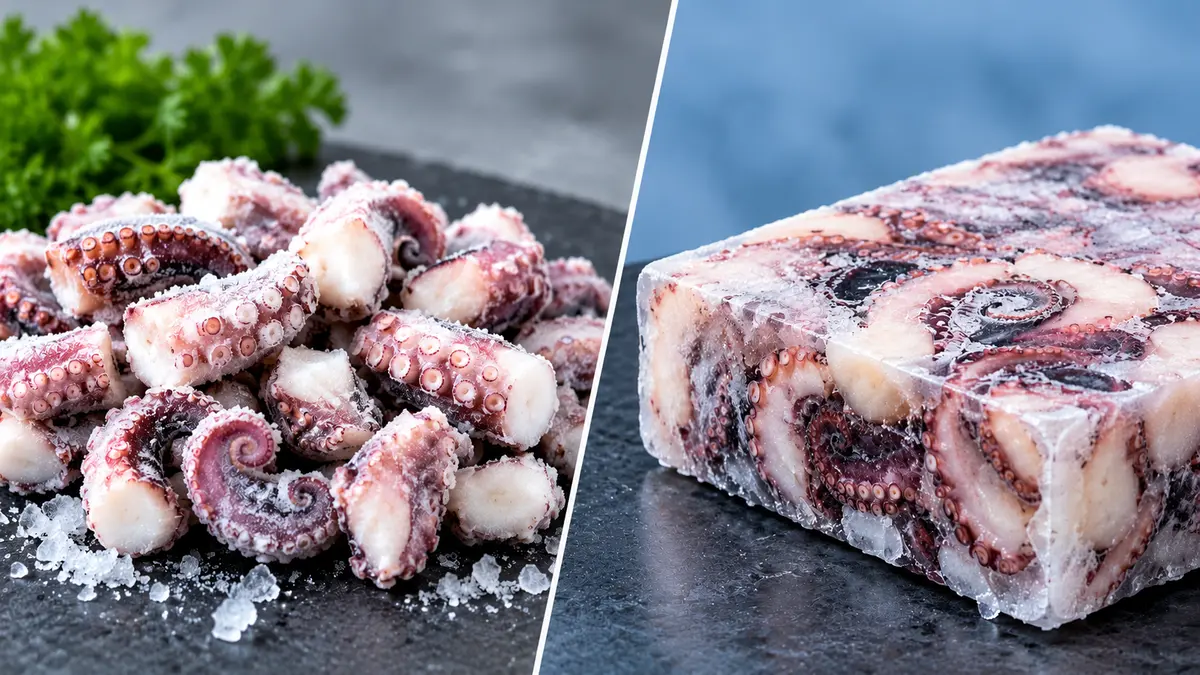
Choosing between frozen seafood formats can influence portion control, inventory costs, storage efficiency, and production planning. For importers, wholesalers, restaurants, and food manufacturers, the choice between IQF and block-frozen octopus is a practical purchasing decision that depends on how the product will be stored, processed, and sold. Understanding the differences helps buyers compare quotations more accurately, minimize avoidable waste, and select a format that fits their operations when sourcing frozen seafood products in Indonesia.
What Is the Difference Between IQF and Block Frozen Octopus?
The main difference is how the octopus is frozen and packed. Individually quick-frozen (IQF) octopus consists of separate frozen pieces, while block-frozen octopus is packed and frozen as a solid mass.
IQF generally offers greater portion flexibility, whereas block freezing is better suited to bulk purchasing, compact storage, and operations that process larger batches. Neither format is automatically better in terms of quality or cost; the right choice depends on product specifications and the buyer’s requirements.
What Is Individually Quick Frozen Octopus?
Individually quick-frozen octopus is frozen piece by piece, so the individual units remain separate. Depending on the product specification, this may include whole octopus, tentacles, or cleaned portions.
Because individual pieces can be selected without thawing an entire block, IQF can be useful for businesses with changing daily demand or different portion requirements.
Typical applications include:
- Restaurants and hotels preparing different serving sizes.
- Retailers and seafood brands selling smaller packs.
- Catering businesses managing fluctuating order volumes.
- Food manufacturers that require flexible ingredient quantities.
- Distributors serving customers with varied product specifications.
However, IQF does not automatically guarantee uniform sizing, superior quality, or lower total costs. Buyers should check size grading, glazing percentage, packaging, net weight, and storage conditions before placing an order.
What Is Block Frozen Octopus?
Block frozen octopus is packed and frozen together in a consolidated block. Depending on the specification, it may contain whole octopus or cleaned and processed pieces.
This format can be practical for processors, wholesalers, and manufacturers that use larger quantities according to a planned production schedule.
Its potential advantages include:
- Compact packaging that can support efficient pallet and container utilization.
- Convenient bulk purchasing for predictable demand.
- Suitability for processing lines that handle large batches.
- Potentially lower purchase prices per kilogram, depending on the supplier and specification.
The main trade-off is flexibility. Depending on the block size, buyers may need to thaw more product than they immediately require. Businesses should evaluate batch sizes, production schedules, and safe handling procedures before choosing this format.
IQF vs Block Frozen Octopus: Which Format Offers Better Value?
The most suitable format depends on the balance between purchase price, operational efficiency, usable product weight, and storage requirements.
| Factor | IQF octopus | Block-frozen octopus |
| Portion control | Individual pieces are easier to select | Usually requires batch planning |
| Thawing | Smaller quantities can be handled separately | Larger quantities may need to be thawed |
| Waste management | Can help reduce leftovers when demand varies | Requires careful planning to avoid unused thawed product |
| Purchase price | May be higher per kilogram | May be lower per kilogram |
| Storage | Packaging may require more space | Compact blocks can support efficient storage |
| Best operational fit | Variable demand and portion-controlled use | High-volume processing and predictable demand |
These are general operational tendencies, not guaranteed outcomes. Actual costs depend on the product, packaging, freezing method, logistics, and handling procedures.
Which Frozen Seafood Format Fits Your Business?
The right format becomes easier to identify when you begin with how the product will be used.
1. Restaurants, Hotels, and Catering Businesses
IQF can be practical for kitchens that serve different portion sizes or experience changing demand. Staff can select individual pieces according to the menu and production requirements.
Block-frozen octopus may suit central kitchens, catering operations, or restaurants that prepare large batches for regular service.
The decision should account for menu volume, freezer capacity, preparation time, and procedures for safely handling thawed seafood.
2. Seafood Wholesalers and Distributors
Wholesalers often serve customers with different purchasing patterns. IQF may be attractive to buyers that prioritize portion flexibility, while block-frozen product can suit processors and customers ordering in bulk.
Some distributors may benefit from stocking both formats if customer demand supports the additional inventory and storage requirements.
For a Seafood Distributor in Indonesia supplying international buyers, matching product specifications to each customer’s needs is more effective than assuming a single format will suit every order.
3. Food Manufacturers and Processing Facilities
Manufacturers should evaluate how octopus moves through their production lines. IQF may be suitable when ingredients are weighed and used in varying quantities. Block-frozen product may work well when entire batches are processed according to a fixed schedule.
Before purchasing, assess equipment capacity, thawing procedures, production volume, and the required final product. A lower purchase price may not be advantageous if additional handling creates operational bottlenecks.
4. Retailers and Frozen Seafood Brands
Retailers should consider pack size, consumer convenience, product appearance, and intended use. IQF can make it easier to portion products into smaller packs, while bulk blocks may suit larger foodservice or family-size formats.
Packaging and labeling requirements should be established before production to ensure the product meets the needs of the intended market.
What Should Buyers Check Before Importing Frozen Octopus From Indonesia?
Choosing a format is only one part of international sourcing. Buyers should also assess product consistency, supplier capabilities, documentation, and cold-chain management.
Product specifications and processing
When sourcing frozen octopus, finding the right specifications for your business is an important step towards a smooth and reliable purchasing process. Factors such as species, size grade, cleaning style, freezing format, glazing percentage, packaging, and net weight can help you identify the most suitable option for your market.
At AB Mandiri, we offer octopus (Octopus vulgaris) in IQF, semi-IQF, and block-frozen formats, available as whole-round or cleaned. Our range provides options for different processing and distribution needs, with availability and specifications confirmed for each order.
Explore our seafood product range to discover the available options and find a format that aligns with your business requirements.
Cold-chain management and quality control
Temperature management is essential for maintaining frozen seafood quality. Buyers should confirm the required storage temperature, packaging integrity, handling procedures, and arrangements for maintaining suitable conditions throughout transport.
AB Mandiri states that its seafood products are processed using an Air Blast Freezer at approximately −40°C and stored at −20°C. These are company-stated processing and storage details; buyers should confirm the specifications and controls applicable to their particular orders.
For further information, read the Seafood Quality Control in Indonesia guide.
Export documentation and destination requirements
Import requirements vary by country and product category. Buyers should establish which health certificates, origin documents, traceability records, labeling details, and other compliance documents are required before confirming a shipment.
Businesses importing into the United States can consult AB Mandiri’s Indonesia Seafood Import FDA Compliance guide as a starting point for understanding relevant considerations. The specific requirements for each shipment should be verified with the appropriate authorities and import specialists.
Packaging, order quantities, and shipping
Discuss minimum order quantities, lead times, packaging specifications, payment terms, shipping arrangements, and procedures for addressing quality concerns.
A reliable seafood supplier in Indonesia should be able to explain the available specifications and clarify which requirements can be met for the intended market. Buyers should request documentation and, where available, product samples before committing to a larger order.
For more guidance on sourcing, read the Reliable Seafood Supply Chain Indonesia guide.
Why Consider CV Anugerah Bahari Mandiri for Frozen Octopus Sourcing?
CV Anugerah Bahari Mandiri, also known as AB Mandiri, is an Indonesian seafood supplier based in Makassar, South Sulawesi. The company supplies seafood products, including fish, squid, cuttlefish, and octopus.
For buyers comparing frozen seafood products in Indonesia, the important consideration is whether the supplier’s available formats, product specifications, documentation, and shipping arrangements match their commercial requirements.
As an Indonesian seafood supplier company, AB Mandiri can be a starting point for discussing the available octopus presentations and sourcing requirements. Buyers can review the company profile and seafood product range before making an inquiry.
There is no need to choose a format before understanding the available options. Share your intended application, approximate monthly volume, preferred product specifications, and destination market to begin a more informed discussion.
When you are ready, visit the AB Mandiri contact page to enquire about product availability and request commercial details.
How Should You Make the Final Decision?
The key to choosing between IQF and block-frozen octopus is understanding how each format fits your operation.
IQF may be more suitable when portion flexibility and variable demand are important. Block-frozen octopus may be a better fit for bulk purchasing, compact storage, and predictable production volumes.
Before committing, compare equivalent product specifications, calculate the cost per usable kilogram, and confirm the supplier’s cold-chain practices and destination-market documentation.
Ultimately, the best format is the one that supports your production needs, customer expectations, and total purchasing economics. If you are exploring frozen octopus sourcing from Indonesia, CV Anugerah Bahari Mandiri can help you start a conversation about available products and specifications.
Frequently Asked Questions
What does IQF mean for octopus?
IQF means individually quick frozen. Each piece is frozen separately, allowing buyers to select individual portions without thawing the entire package.
Is block-frozen octopus lower quality than IQF?
Not necessarily. Product quality depends on freshness, processing, handling, and cold-chain management, not simply the freezing format.
Which format is better for restaurants?
IQF can suit restaurants with variable demand and portion requirements. Block-frozen product may suit high-volume kitchens preparing predictable batches.
How should frozen octopus be stored?
Follow the supplier’s storage instructions and applicable food safety requirements. Maintain the required frozen temperature and avoid unsafe thawing or temperature fluctuations.
What is glazing, and why does it matter?
Glazing is a protective layer of ice applied to frozen seafood. Buyers should confirm the declared percentage and the applicable net-weight basis.
Can buyers order both formats from one supplier?
Potentially, depending on the supplier’s product range and availability. Confirm specifications, minimum order quantities, and packaging options for each format.
How do I choose a seafood supplier in Indonesia?
Evaluate product specifications, quality control, traceability, documentation, export experience, communication, and the supplier’s ability to meet your destination market requirements.
How can I request an octopus quotation from AB Mandiri?
Visit the AB Mandiri contact page and share your product requirements, estimated volume, and destination market.